


Since April, southern China has seen frequent rainfall. Will it continue into May?
Since April, southern China has been frequently drenched by rain, with regions like South China enduring relentless bouts of heavy rainfall and severe convective storms. The Beijiang River in the Pearl River Basin experienced catastrophic flooding, while localized powerful tornadoes in Guangzhou caused casualties. How much rain has actually fallen in the south this month? Why has the early flood season in South China been so intense this year? As we enter May, will the rains in the south continue?
Since April, cumulative rainfall in eastern Guangdong has exceeded 500 millimeters, with Longmen receiving over five times the average for this time of year.
Statistics from the National Climate Center indicate that from April 1 to 28, cumulative precipitation exceeded 100 millimeters across most regions south of the Yangtze River and in southern China. Areas including central and eastern Guangdong, southern and western Fujian, eastern Guangxi, southern Hunan, southern and eastern Jiangxi, and southwestern Zhejiang recorded over 300 millimeters. Eastern Guangdong and localized areas in Jiangxi and Fujian even surpassed 500 millimeters.
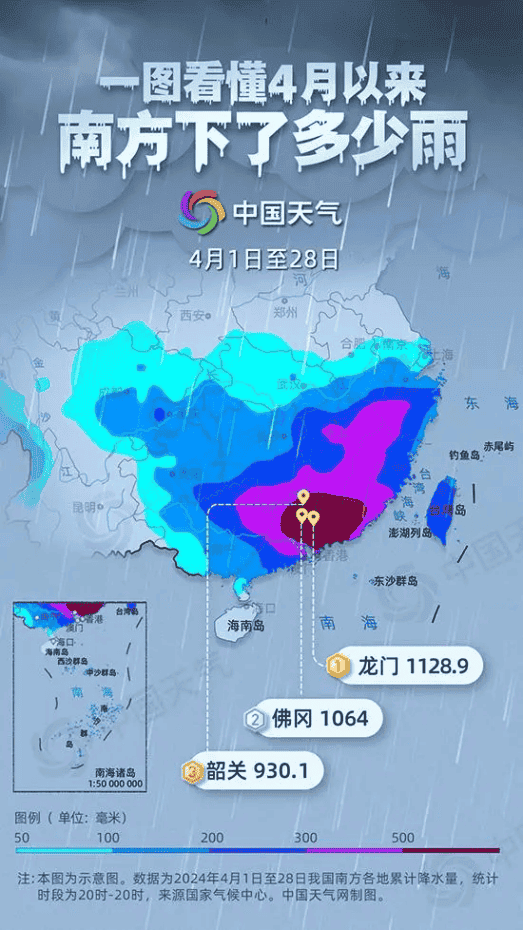
Among national meteorological stations, the top three in cumulative precipitation were all located in Guangdong. Longmen ranked first with a cumulative rainfall of 1,128.9 millimeters—more than five times the average for the same period—while Fogang, in second place, also exceeded 1,000 millimeters.
Due to persistent heavy rainfall, water levels in multiple rivers across the Pearl River Basin have surged dramatically. On April 22, the Beijiang River experienced an exceptionally severe flood, followed by the third major flood of the year on the Hanjiang River on the 28th. Additionally, flash floods and geological hazards have occurred in numerous areas of Guangdong, with localized severe urban flooding affecting some towns and cities. On the afternoon of April 27, influenced by a strong convective cloud cluster, hailstones larger than 5 centimeters in diameter fell in localized areas of Guangzhou. A powerful tornado also struck Zhongluotan Town in Baiyun District, resulting in 5 deaths and 33 injuries.
Heavy rainfall accompanied by severe convective weather will persist in southern China's Jiangnan and South China regions over the next two days, posing significant disaster risks in Guangdong, Guangxi, and other areas.
Starting last night (April 28), a new round of heavy rainfall and severe convective weather has intensified across southern China. According to Zhang Juan, a meteorological analyst at China Weather Network, today's heavy rainfall will primarily affect the Jiangnan region and northern parts of South China. Tomorrow, as a cold front moves southward, the heavy rain zone will shift further southward to South China, bringing mainly heavy to torrential rain with localized extreme downpours. This will be accompanied by severe convective weather, including short-term winds of force 8 to 11, lightning, hail, and intense localized precipitation.
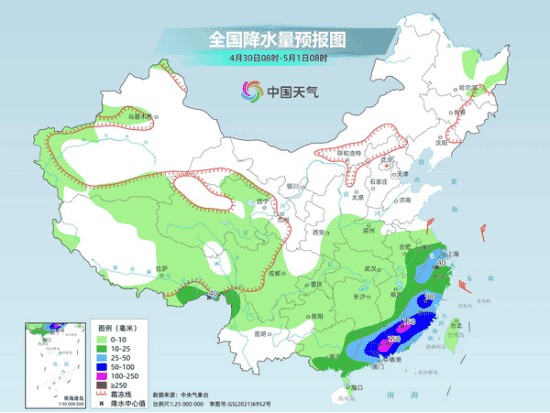
Since April, southern China has experienced above-average rainfall and frequent severe convective weather. Cumulative precipitation in southern Jiangnan and northern Guangdong has already significantly exceeded the long-term seasonal average. The current heavy rainfall zone overlaps extensively with areas that previously received above-average precipitation. Provinces including Guangdong, Guangxi, Fujian, Jiangxi, Hunan, and Chongqing face high disaster risks and require heightened vigilance.
Why Did South China's Pre-Flood Season Start So Strongly This Year? How Much Longer Will Heavy Rainfall Continue?
The early flood season in South China refers to the rainy period occurring from April to June in the region. Typically, late May to mid-June marks the peak of this period, coinciding with the Dragon Boat Festival celebrations, hence its alternative name "Dragon Boat Water." However, this year's early rainy season in South China has defied expectations: not only did it begin five days earlier than usual, but it also kicked off with the full force characteristic of the "Dragon Boat Water" phenomenon.
Since the onset of the early flood season in South China this year, the subtropical high has been unusually strong, continuously supplying abundant moisture to the region. This has coincided with persistent southward incursions of cold air masses from the north, creating a standoff with warm, moist air currents. This dynamic has triggered prolonged heavy rainfall and severe convective weather. Simultaneously, the development of low-pressure troughs and the persistence of the low-level southwest jet stream have facilitated the formation of a 'train effect' in South China following convective activity. This phenomenon results in prolonged rainfall periods and cumulative impacts in the region," stated Zhang Juan.
Following this round of heavy rainfall, southern regions are expected to transition to light rain or cloudy conditions from May 1 to 2. However, scattered showers will persist in South China, with localized heavy rain along the Guangdong coast. Looking ahead, from May 3 to 5, as warm and moist air currents strengthen again, southern China will experience another round of heavy rainfall. Moderate to heavy rain is expected in the Jianghan Plain, the Yangtze-Huai River region, the Jiangnan region, South China, as well as Chongqing and Guizhou, with localized torrential rain or extremely heavy rain. This will be accompanied by severe convective weather.
During the first two days of the May Day holiday, rainfall in southern regions briefly subsided. However, local soil moisture levels had already reached saturation, and geological hazards exhibit a certain degree of delayed response. Therefore, the public is advised to avoid hazardous areas such as geological hazard sites, river channels, and low-lying flood-prone zones during holiday travel and prioritize safety. As heavy rainfall is expected to resume during the latter part of the holiday, residents in southern regions must pay close attention to forecasts and warnings issued by meteorological authorities and take preventive measures in advance.