


Emergency rescue hovercraft with a water speed of 40 km/h, a powerful tool for rescue operations on
Rescue operations face numerous challenges in complex and variable geographical environments such as grasslands, wetlands, and ice surfaces. In grassland areas, despite the open vistas, the terrain is intricate, making vehicle navigation extremely difficult. Vehicles often become bogged down in mud, hindering operations. Entering wetlands, their soft geological properties render conventional vehicles nearly unusable, with becoming mired in deep mud being a common risk. Ice surface rescues, meanwhile, are fraught with even greater uncertainty and danger, as inconsistent ice thickness and hidden cracks pose potential threats to any form of movement. These unique terrain conditions undoubtedly present enormous challenges to rescue operations, placing extremely high demands on the capability and adaptability of rescue equipment.
So, how to swiftly and safely execute rescue missions in these complex terrains remains an ongoing concern for us.
During a flood disaster in Southeast Asia, many areas transformed into temporary wetlands and waterways, rendering traditional rescue vehicles and boats inaccessible. Emergency rescue hovercraft demonstrated their unique advantages, navigating freely through the flooded wetlands to deliver urgent medical aid, food, and clean water to stranded residents. They even assisted in evacuating large numbers of affected people to safe zones.
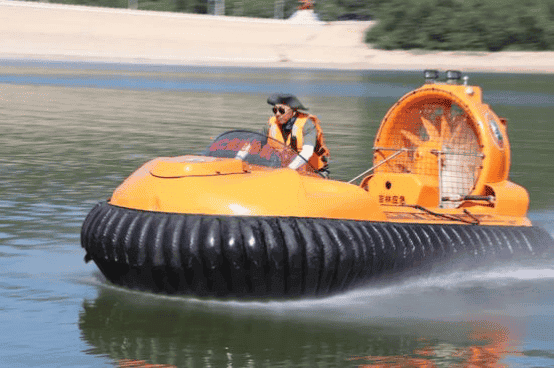
The emergency rescue hovercraft is an emergency response vehicle designed for rescue operations in grassland wetlands and on ice surfaces. Integrating both vehicle and vessel capabilities, it seamlessly transitions between land and water environments. Capable of traversing shallow riverbeds and floating on water surfaces, it meets rescue demands in post-disaster scenarios and complex aquatic terrains.
In terms of equipment configuration, it integrates a high-performance engine and propulsion system, along with a comprehensive control system and auxiliary rescue equipment such as life buoys, megaphones, and searchlights. The emergency hovercraft features a specialized design offering excellent stability and buoyancy. With a 40-liter fuel tank capacity, it can travel approximately 400 kilometers. According to official data, this craft achieves a maximum unloaded speed of 56 km/h on water and 40 km/h when fully loaded. It accommodates four passengers with a maximum payload capacity of 400 kg, enabling rapid deployment to accident sites to secure critical rescue time.
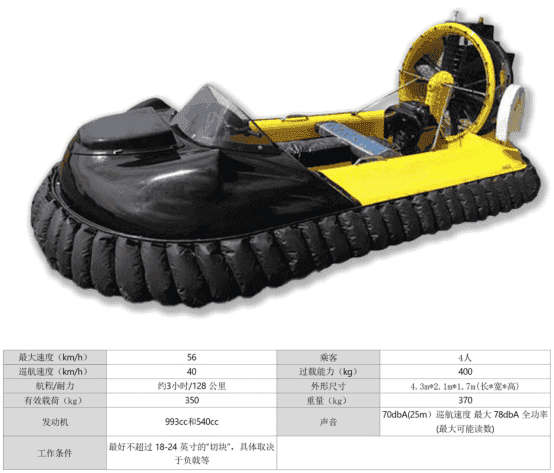
The principle behind its amphibious design lies in utilizing high-pressure air to form an air cushion between the hull and the water surface (or ground), lifting the vessel off the water (or ground) and thereby significantly reducing navigation resistance. Emergency hovercraft are equipped with powerful blowers that compress air into the air cushion chambers beneath the hull. Once these chambers are filled to form a high-pressure air cushion, they effectively support the entire vessel. The onboard propulsion system then generates thrust, propelling the hovercraft forward.
Therefore, emergency rescue hovercraft are not constrained by water depth or underwater terrain, enabling them to navigate complex waterways such as shoals, marshes, and rapids with ease. Additionally, the cushioning effect of the air cushion ensures a relatively smooth ride, minimizing the impact of turbulence on personnel and cargo onboard. This makes them an ideal choice for complex rescue scenarios.