


首页 >>
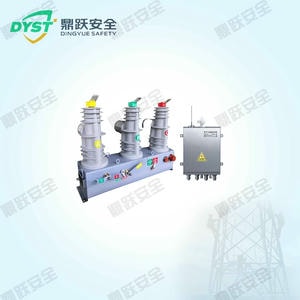
名称:New Integrated Primary-Secondary Fault Location Device for Pole-Mounted Circuit Breakers
型号:
I. Requirements Analysis The existing distribution network suffers from mismatched primary and secondary equipment interfaces, resulting in poor compatibility, scalability, and interchangeability; There is a lack of a coordinated testing mechanism for primary and secondary equipment. To address the issues of incremental equipment coverage in distribution automation and mismatched primary/secondary equipment during large-scale distribution network construction and upgrades, while achieving the go
产品详情
I. Requirements Analysis
The current distribution network suffers from mismatched primary and secondary equipment interfaces, resulting in poor compatibility, scalability, and interchangeability; There is a lack of a coordinated testing mechanism for primary and secondary equipment. To address the challenges of expanding distribution automation coverage for incremental equipment and resolving primary-secondary mismatches during large-scale distribution network upgrades, while achieving the goal of simultaneous "four-tier" line loss management (by zone, voltage level, component, and transformer district), and to advance the implementation of simultaneous line loss management for 10(20/6) kV feeder circuits, continuously improving the precision of line loss management and enhancing operational efficiency, our company introduces a new integrated primary-secondary pole-mounted circuit breaker fault location device that perfectly resolves these challenges.
II. Working Principle
By enhancing the standardization and integration of primary and secondary distribution equipment, we improve the operational performance, maintenance quality, and efficiency of distribution equipment. This meets the technical requirements for line loss management and supports the action plan for distribution network construction and transformation. With the technical goal of achieving "safety, reliability, integration, and efficiency," and guided by demand with testing as assurance, the initiative primarily targets incremental equipment in distribution network construction and renovation. Following the principles of standardized overall design, independent functional modules, and flexible equipment interchangeability, it prioritizes addressing urgent issues in distribution automation construction—such as compatibility and scalability of primary-secondary interfaces, adding new energy measurement functions to terminals, and remote signaling jitter. This phased approach advances the integration of primary and secondary distribution equipment.
III. Features and Functions
Complete set of functional requirements
1. Fault-location-capable primary-secondary integrated circuit breakers can be used for line sectioning, interconnection, branching, boundary demarcation, and similar applications.
2. The primary-secondary integrated standardized column-mounted circuit breaker comprises the switch body, feeder terminal, power supply voltage transformer, voltage transformer, current transformer, and connecting cables. The feeder terminal integrateswave value acquisition functionality, with the voltage transformer/sensor and current transformer/sensor meeting traveling wave sampling requirements;
3. Military-grade aviation connectors are used between the switch body, feeder terminals, and power voltage transformers, connected via outdoor-rated fully insulated cables. Exposed aviation connectors must seal metal conductors with waterproofing materials to enhance condensation resistance. Cable entry points for power voltage transformers require rainwater ingress protection and U-shaped clamps during installation. The cable controller side must feature a lower U-shaped clamp to prevent rainwater from flowing into the connector along the cable.
4. Capable of collecting three-phase currents, zero-sequence currents, three-phase phase voltages, or one line voltage and one zero-sequence voltage on each side of a switch, to fulfill the functions of calculating active power, reactive power, power factor, frequency, and energy collection.
5. Flexibly configure operating parameters and control logic based on actual operating conditions to handle single-phase-to-ground and phase-to-phase short-circuit faults. Direct tripping can isolate faults, with the inherent action time for phase-to-phase faults not exceeding 100 ms. Features three automatic reclosing attempts, with adjustable reclosing frequency and time intervals.
6. Provides detection and protection capabilities for phase-to-phase short-circuit faults and single-phase ground faults in low-resistance grounding systems. Supports three-stage protection for phase-to-phase short circuits, with configurable settings for all three stages' values and time delays. Supports two-stage zero-sequence protection, with configurable settings for both stages' values and time delays.
7. Capable of local identification and isolation of single-phase ground faults in low-current grounding systems, with ground fault alarm and local disconnection functions.
8. Supports both centralized feeder automation and local feeder automation functions, with the ability to switch automation modes via preset value configuration.
9. Supports the three-remote configuration requirements for distribution automation. Terminals are equipped with local/remote switchover functionality. When information security conditions are met, remote control capabilities can be enabled without altering the hardware equipment.
IV. Technical Specifications
| Serial Number | Project Name | Technical Specifications |
| 1 | Vacuum circuit breaker | Pillar-type, rated short-circuit breaking current, number of breaking operations ≥30 times |
| 2 | Operating mechanism | Electric operation with manual override capability; instantaneous power during closing and opening ≤480W |
| 3 | Transformer Combination Mode | Includes electromagnetic current transformers, electromagnetic voltage transformers, and zero-sequence voltage sensors. |
| 4 | Feeder Terminal Unit (FTU) | (1) Telemetry; Telemetry; Remote Control: Acquire one line voltage; collect three-phase currents, zero-sequence current, and zero-sequence voltage; |
| At least 3, including switch closing position and de-energized status remote signals; 2 channels (closing, tripping) | ||
| (2) Voltage measurement accuracy: Phase voltage: ≤0.5% (Class 0.5), Zero-sequence voltage: 3P | ||
| (3) Current measurement accuracy: Phase measurement value 0.5 class (≤1.2In), zero-sequence current ≤3% | ||
| (4) Supports 4G/3G/2G five-mode adaptive operation | ||
| 5 | Fault Location | Traveling wave current sensor frequency response range; Traveling wave current sampling rate: 1 kHz to 1 MHz; ≥1 MHz |
| Number of monitoring channels for traveling wave current: 3 channels for faults | ||
| Current Sensor Frequency Response Range: 20Hz to 1kHz Fault Current Measurement Range | ||
| Fault Current Amplitude Measurement Error: 0.5 to 6000 A; ±5% and ±0.5 A | ||
| Number of fault current monitoring channels: 3 channels GPS | ||
| Beidou-2 Integrated Positioning System Synchronized Clock Accuracy: ≤0.1 microseconds | ||
| 6 | Primary and Secondary Integration Package | Fault Trip: Capable of automatically isolating phase-to-phase short circuits and ground faults on the customer side. Proactively transmits fault information upon occurrence of a customer-side fault. |
| Fault clearing time: The inherent operation time for the entire unit shall not exceed 100 ms, with the FTU operation time not exceeding 40 ms. | ||
| Feeder Automation: Supports centralized and local feeder automation, with the capability to engage and disengage. | ||
| 7 | Switch Enclosure Protection Rating | Not less than IP65 |
| 8 | Primary and Secondary Equipment Connection Design | Control Connection Method: The switch body is equipped with a 26-pin aviation connector assembly, including a connection cable. |