


首页 >>
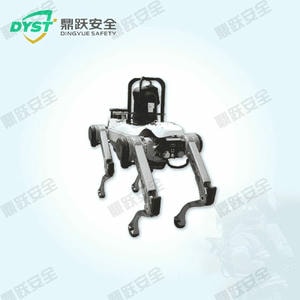
名称:Four-legged Inspection Robot
型号:
The quadrupedal inspection robot is a highly intelligent inspection device designed for complex terrains and multi-domain applications. It features all-terrain adaptability and exceptional obstacle-crossing capabilities, effortlessly traversing slopes, grasslands, snowfields, gravel surfaces, and other challenging terrains—even operating across different floors. These robots typically carry advanced equipment including 3D LiDAR, high-definition cameras, and dual-spectrum thermal imaging gimbals.
产品详情
I. Requirements Analysis:
Digital transformation has been incorporated into China's 14th Five-Year Plan and the long-term goals for 2035. As the new round of technological revolution and industrial transformation deepens, digitalization and intelligentization have become new engines driving high-quality industrial development. As critical infrastructure, the stable operation of power facilities such as substations is paramount to social and economic progress. Power substation inspections are highly repetitive and labor-intensive, often conducted in complex terrain. Most domestic substations rely on traditional manual patrols, which are constrained by factors such as inspectors' skill levels and experience. This leads to frequent instances of missed inspections, misidentifications, and undetected defects, ultimately causing circuit failures. Manual inspections struggle to fully meet the safety requirements of modern substations. Meanwhile, traditional power inspection robots are predominantly wheeled, limiting their ability to operate continuously across irregular terrains such as multi-level structures, stairs, grassy areas, and muddy surfaces.
II. Working Principle
The intelligent quadrupedal robot, as an intelligent device integrating locomotion capabilities such as walking, running, jumping, and recovering from falls, has demonstrated high adaptability to unstructured outdoor terrain in substations—including pebbles, grassy areas, and steep slopes—without altering the original environment. It has also successfully navigated various obstacles at boundary points, such as steps and staircases, achieving comprehensive coverage across all scenarios for inspection robots within substations.
III. Features and Functions
Full-scenario coverage will enable more efficient power inspections for electrical systems:
1. Significantly expand robotic inspection coverage: Quadruped robots can cover substations spanning 25,000 square meters.
2. Bridging outdoor and indoor inspection scenarios: Previously, separate robots were required for outdoor and indoor environments in substations. Quadrupedal robots can navigate diverse terrains both indoors and outdoors while overcoming boundary obstacles, thereby reducing inspection costs and enhancing management efficiency.
3. Enhanced Inspection Efficiency and Data Quality: Compared to traditional wheeled robots, quadrupedal robots can traverse obstacles, shorten inspection routes, and select more optimal observation positions. Omnidirectional autonomous navigation, intelligent recognition, smart inspection; utilizing SLAM (Simultaneous Localization and Mapping) based on LiDAR, the quadrupedal robot achieves model-free point cloud mapping in substations. It collects 3D point cloud data within a 25,000-square-meter substation in approximately 20 minutes, autonomously plans omnidirectional navigation paths according to task models, and reports coordinate information in real time. The quadruped robot's AI computing power enables on-site target detection in a small closed-loop system, tolerating deviations caused by environmental disturbances. Deep learning-based algorithm models achieve target status recognition and temperature detection.
IV. Product Specifications
| Serial Number | Category | Name | Technical Specifications |
| 1 | Entity size | Dimensions when laid flat (Length × Width × Height) | 1070mm×470mm×346mm |
| Dimensions when standing(Length × Width × Height) | 950mm×470mm×700mm | ||
| Total weight | 53kg | ||
| 2 | Electrical Parameters | Battery capacity | 19.5Ah (ideal data measured at 25°C ambient temperature) |
| Battery rated voltage | 72V | ||
| No-load operating time | 4h | ||
| Payload endurance time | 2h | ||
| Charger Input | 200V~240V | ||
| Charger Output | 84V/8A | ||
| Charging duration | 11 p.m. to 3 a.m. | ||
| External Power Supply Connector | 5V; 12V; 24V; 72V(BAT) | ||
| External Communication Interface | Ethernet; WiFi; USB; RS485/RS232 | ||
| Autonomous Charging Function (Optional) | Support | ||
| 3 | Motion Parameters | Maximum speed | 4.95 m/s (maximum test data) |
| Maximum walking speed | 1.7 m/s | ||
| Maximum climbable slope gradient | ±30° | ||
| Maximum climbable step height | 18cm | ||
| payload | 20kg | ||
| Maximum load | 85kg (maximum load test data) |